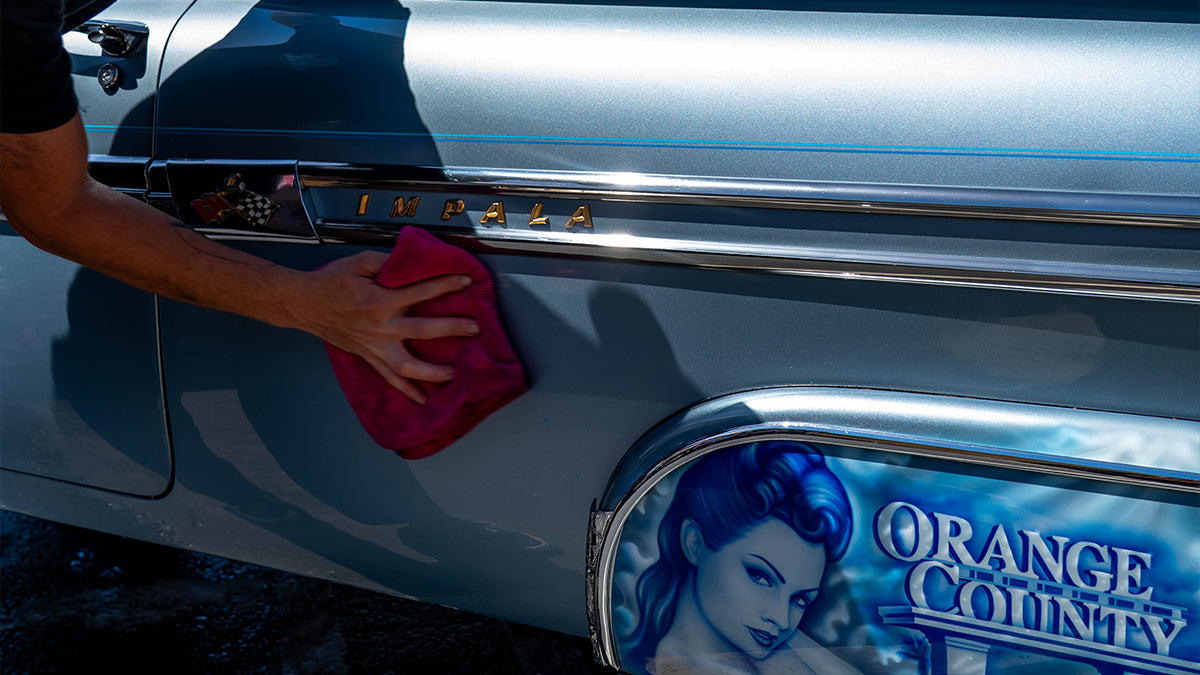
You paid real money for that candy, pearl or flake job. The sun will take it apart for free, a little every day it's parked outside, and you won't notice until the color looks flat next to a fresh build at the show.
UV protection for custom paint comes down to two things: keep a UV-blocking layer on the clear coat at all times, and renew it as part of your normal wash instead of as a special project. This guide covers how UV fades a lowrider, why candy goes first, and the routine that keeps the color deep.
How Does UV Damage Custom Paint?
Ultraviolet light carries enough energy to break chemical bonds. On a car, it attacks the clear coat first. Over time the clear loses its clarity, goes hazy, then chalky, and eventually starts to fail.
Once the clear is compromised, UV gets to the color layer underneath. That is when you see real fading: reds go pink, blues go dull, and candy loses the depth that made you pick it.
It happens on cloudy days too. UV gets through cloud cover, so "it wasn't that sunny" is not a defense. For the full breakdown, read How UV Rays Destroy Car Paint.
Why Does Candy Paint Fade Faster Than Solid Colors?
Candy gets its depth from translucent tinted layers over a reflective base. Light passes through the color, hits the base and bounces back, which is why candy looks like you could reach into it.
That same translucency is the weakness. The tint layer is doing all the color work, and tinted layers are generally more vulnerable to UV than the dense pigments in a solid color. When the tint fades, there is no backup. The base starts showing through and the depth goes with it.
Pearl and flake have their own issue: as the clear above them hazes, they stop sparkling. The effect is still there. You just can't see it through a cloudy clear.
Bottom line: custom paint needs UV protection more often, not less. Our guide to protecting candy paint on a lowrider covers the rest of the candy-specific care.
What Is SunShield UV, and Where Does It Come From?
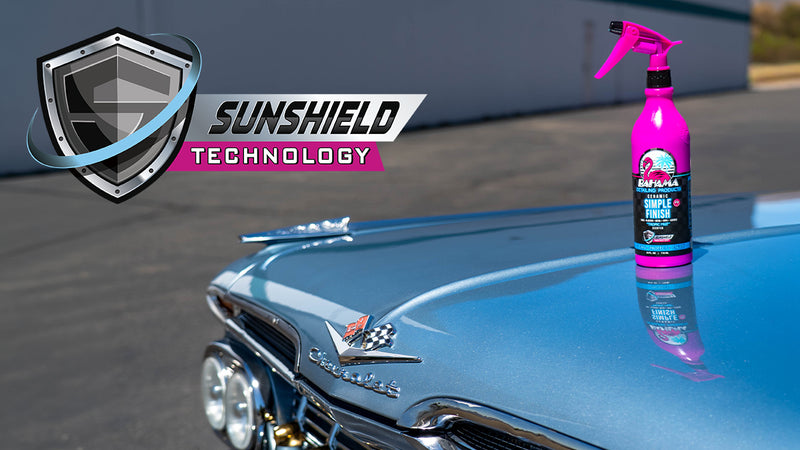
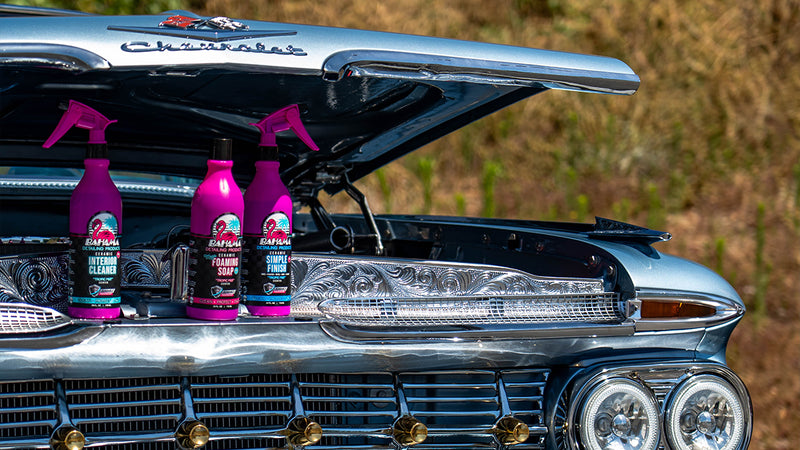
SunShield UV is built into all four Bahama bottles, not sold as a separate product. Every time you wash, restore or protect with the system, you are laying UV protection back down.
- 98% of UV blocked at the clear coat across the 290-400nm range.
- 14 days still beading and UV shielded in Sun Belt testing.
- Battle-tested in 108°F Sun Belt sun.
The carrier is graphene plus SiO₂. Graphene is a single-atom carbon lattice, 200x stronger than steel. SiO₂ is liquid glass. Together they make the surface hydrophobic, and the layer builds with every application. If you want the technical side, see What Is SunShield UV Technology?
Your strongest UV layer on the paint comes from Ceramic Final Touch Detail Spray, the most ceramic of the four bottles. The soap, the restorer and the interior cleaner keep topping it up around it.
How to Protect a Lowrider's Paint From UV: The Routine
Do this in the shade, on cool panels. Hot paint dries everything too fast and makes streaks more likely.
1. Wash
Foam the car with Ceramic Mega Foaming Soap. It is pH neutral and safe on any coating, so it cleans without stripping the protection you already built, and it leaves a beading ceramic and SunShield UV layer of its own. Use a soft mitt and a Grit Guard Bucket so grit stays at the bottom of the bucket and off the candy.
Wire wheels and the tires get their own brush and mitt. Never bring wheel grime back to the body.
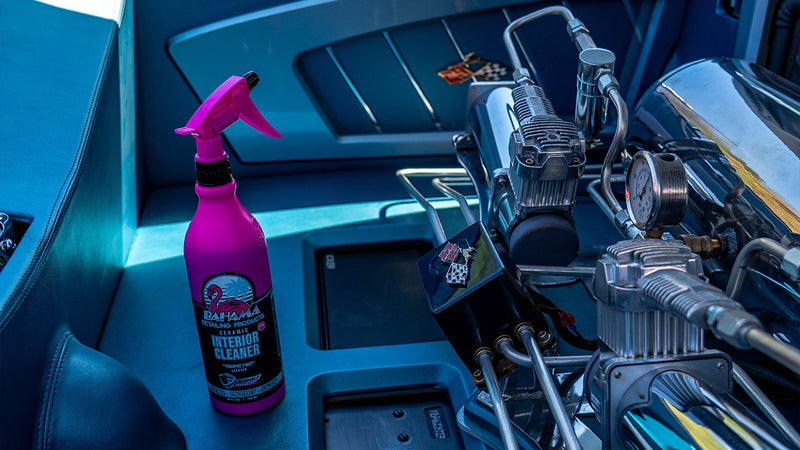
Inside, wipe the dash, door panels, vinyl and leather with Ceramic Interior Cleaner on a Starting Line towel. Custom interiors bake through the glass too, and this lays down UV protection in the same pass.
2. Dry
Water spots are made in the drying, not in the wash. Sheet the hood, roof and trunk with a Big Bird, blotting rather than dragging. Use a Lil' Bird for the mirrors, glass, door jambs and the tight lines around trim and emblems.
3. Restore
Tires, rubber seals, black trim and any vinyl outside the paint fade just as fast as the color does. Spray Ceramic Simple Finish, wipe it in with a Finish Line towel, and walk away. On painted wheels you can do the tire and rim together, with a quick buff after on gloss rims. Chrome wire wheels are different: Simple Finish on the tire only. Our guide to lowrider chrome wheel cleaning covers the spokes.
Keep Simple Finish off the candy, the glass and the chrome. Those surfaces get Final Touch.

Faded plastic, trim, rubber and tires back to like-new, then protected. Just as good on matte, satin, PPF and vinyl wrap.
4. Protect
One panel at a time: spray Final Touch on the paint, wipe it smooth into a consistent layer, and let it dry 5 minutes. Do the glass and the chrome bumpers, trim and wheels the same way. Chrome dulls in the sun too, and this is the bottle built for it.
5. Finish
Buff each panel with a dry Victory Lap. It lifts the residue while the coating stays on the paint, leaving it clear, streak-free and slick. Never buff Final Touch with the Birds; the drying towels drink the coating off the panel.
Keep the car dry for about 24 hours after a full coat so it cures. A full coat takes about an hour from wash to finish and lasts 3 to 6 months.

The most ceramic of the four. Spray it on, wipe it smooth into a consistent layer, let it dry for 5 minutes, then buff. What is left is a streak-free, water-spot-free, ultra hydrophobic ceramic layer with UV protection.

The towel for buffing Ceramic Final Touch. 450 GSM edgeless plush lifts the residue while the coating stays on the paint.
Is Garage Storage Enough UV Protection?
A garage helps a lot, but it is not a force field. UV comes through windows and open doors, and a car that cruises and shows spends plenty of hours outside anyway.
Treat the garage as one layer of defense and the coating as another. A covered, protected car is in far better shape than either one alone.
If you use a cover, only put it on a clean car. A cover over dust becomes sandpaper every time it shifts.
How Do You Spot Early UV Damage on Custom Paint?
Look at the horizontal panels first: hood, roof and trunk take the most direct sun.
- Early: color looks a little flat compared to the door sills or areas under trim. Candy loses some depth.
- Middle: a dry, hazy look that comes back right after a wash and disappears again within days.
- Advanced: chalky residue on your hand, or fine cracks in the clear. At that point you need a professional painter's opinion, not a product.
Early dullness can often be improved with a light polish by a careful hand or a pro, followed straight away by a fresh protection layer. Final Touch is not a polish and won't remove damage. Its job is to keep the next round from happening.
Frequently Asked Questions
Does window tint protect my paint from UV?
No. Tint filters UV coming through the glass into the cabin. Exterior paint is directly exposed and needs its own protection layer.
Can UV damage chrome?
Sun and weather dull chrome over time. Protect it with Final Touch, buffed with a Victory Lap, the same way you protect the paint. Simple Finish is not for chrome.
How often should I reapply UV protection on candy paint?
Every wash with Mega Foaming Soap tops up the layer. Put down a full Final Touch coat when water stops beading the way it did; a full coat lasts 3 to 6 months.
Is Final Touch safe on candy, pearl and flake?
Yes. Final Touch is not abrasive and not a polish. It lays down a protective layer on top of the clear without cutting into it.
Protect the Paint You Paid For
Custom paint is expensive to build and painful to redo. Keeping it protected is cheap by comparison when it rides along with every wash. The Full System Set gives you all four bottles, each with SunShield UV, so the paint, chrome, trim and interior are covered in one routine.

Wash, interior, restore and protect: all four Bahama ceramic bottles in one set. A pro ceramic coating is $1k+. This system only takes a couple hours.

Drying, interior, wheels and trim, and buffing the Final Touch coating, each with its own towel. No wheel grime on the dash, no drying towel soaking up your coating.