UTV tires take more abuse than any other part of a side-by-side. Mud packs into the tread, clay bakes onto the sidewalls, and brake dust and trail grime build up on the wheels until the whole corner looks gray and tired.
Good UTV tire and wheel care comes down to three moves: get the tread and wheels properly clean, dry them so nothing spots, then dress the rubber and the rim together with a product that protects and does not sling. This guide walks you through each one.
It also covers the mistakes that make dressing look patchy or fly off onto your plastics on the first ride out.
Why Do UTV Tires Need Their Own Care Routine?
Side-by-side tires are not car tires. The tread blocks are deep and widely spaced, the sidewalls are tall, and the rubber spends its life in mud, sand, rock and water.
That exposure does two kinds of damage. Packed mud and clay hold moisture and grit against the rubber and the wheel. Sun breaks rubber down over time, which is why an outdoor-parked machine ends up with brown, chalky sidewalls long before the tread wears out.
Wheels have their own problem. Brake dust and trail grime are gritty, and on painted, powder coated or machined rims they dull the finish fast if you leave them sitting.
How to Clean UTV Tires and Wheels, Step by Step
Work one corner at a time, and do the wheels before the body so you are not splashing grime onto panels you already washed. If you are washing the whole machine, our guide on removing mud from a UTV without scratching the plastics covers the body side.
What you need
You do not need a shelf of single-purpose bottles. You need the right tools and a short list of products that each do one job well.
- A hose with a wide fan nozzle to soften and flush mud without blasting it into bearings and seals.
- A stiff tire brush for tread blocks and sidewalls, and a soft wheel brush for spokes, lug pockets and the barrel.
- Ceramic Mega Foaming Soap in a foam cannon or a Grit Guard Bucket. It is pH-neutral, so it is safe on painted and powder coated wheels.
- Big Bird and Lil' Bird drying towels.
- Ceramic Simple Finish and its paired Finish Line towels for the tire and rim.
Keep your wheel brushes and wheel towels for wheels only. A towel that has been through brake dust and tire dressing has no business on your dash or your paint.
Step 1: Soak and flush the mud
Wet the tire and wheel thoroughly and let the water soak in for a minute. Dried mud releases far more easily once it is saturated.
Flush the bulk of it out of the tread and the wheel barrel with a wide fan. Keep the spray moving and off the wheel bearings and hub seals, where high pressure can push water past the seal.
Step 2: Foam and scrub the tread
Cover the tire in Mega Foaming Soap and give it a moment to start lifting. Then work the stiff brush across the tread blocks and up the sidewall.
When the foam turns brown, that is old dirt and faded rubber coming off. Rinse and repeat until the foam stays white. Clean rubber is what lets the dressing bond later.
Step 3: Clean the wheel
Switch to the soft wheel brush. Work the face, then the spokes and lug pockets, then reach into the barrel. Rinse from the top down.
On beadlock wheels, take extra time around the ring bolts, where grit loves to sit. On a fresh wheel with a gloss finish, use light pressure and let the foam do the lifting.
Step 4: Dry it, do not air dry it
Water spots are made in the drying, not in the wash. Blot the wheel face and sidewall with a Big Bird, then use a Lil' Bird to get into lug pockets, spokes and around the valve stem.
Blot rather than drag. Drying the rubber properly matters too, because dressing will not bond to a wet tire.

Thick cannon foam that lifts road film, mud and bug guts, then leaves a beading ceramic layer behind. pH-neutral, so it is safe on any coating.
How to Dress UTV Tires Without Sling
This is where most people go wrong. Traditional tire shine is an oily layer that sits on top of the rubber. It looks wet for a day, then flings off the first time the tire spins up, right onto the plastics you just cleaned.
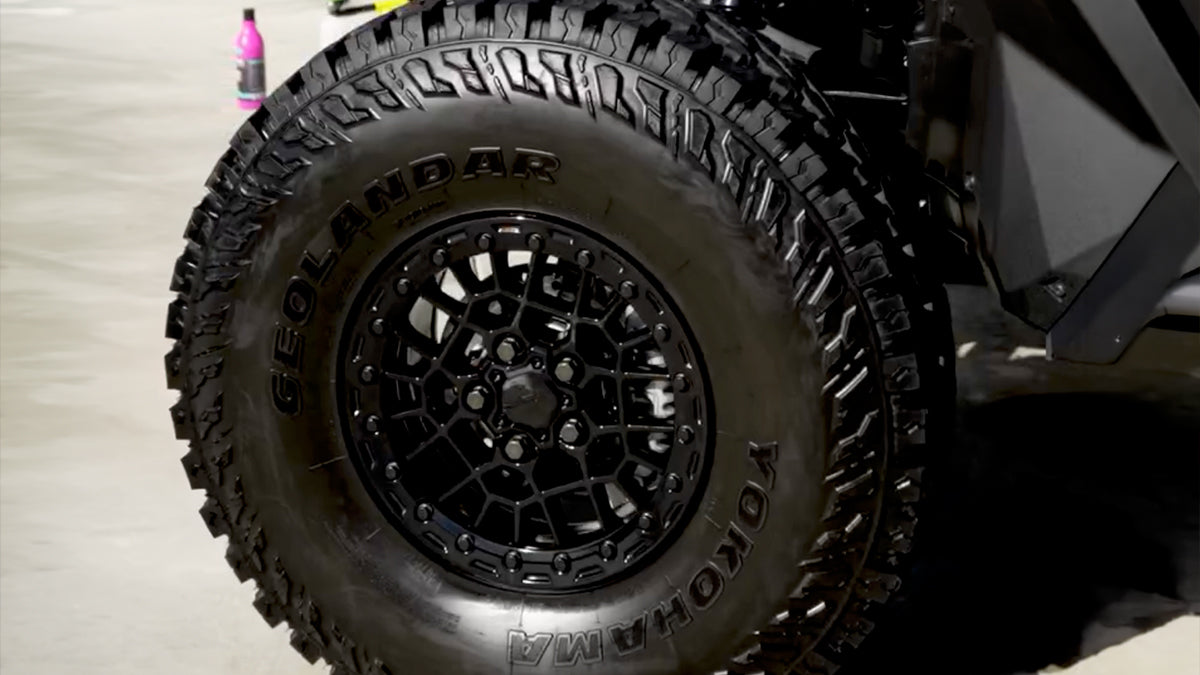
Ceramic Simple Finish works differently. It is a spray and wipe restorer for rubber, plastic, trim and wheels, so you treat the tire and the rim together in one pass. It brings faded rubber back to a rich, dark finish and leaves SunShield UV protection behind, with no sling.
Step 5: Restore the tire and rim
- Make sure the tire and wheel are clean and fully dry.
- Spray Simple Finish onto a folded Finish Line towel, or lightly onto the sidewall.
- Work it into the sidewall with the short-nap side, which grabs any last grime.
- Wipe the rim face and spokes with the same product.
- Flip to the plush side and wipe everything even so there is no excess sitting in the lettering.
- On gloss rims, give the face a quick buff after so it stays crisp.
Finish Line is dual-sided for exactly this kind of dirty work, and it means your finishing towels never touch brake dust or tread grime. If you want to stretch the life of the dressing even further, read our guide on making tire dressing last longer.
Keep Simple Finish off the windshield and any glass. It is built for rubber, plastic, trim and wheels, not clear surfaces.

Faded plastic, trim, rubber and tires back to like-new, then protected. Just as good on matte, satin, PPF and vinyl wrap.
Where Does Final Touch Fit on a Side-by-Side?
Not on the tires. The rubber and the rim belong to Simple Finish. Ceramic Final Touch Detail Spray is the protect step for the rest of the machine: painted panels, glass and chrome.
Step 6: Protect the painted parts and the windshield
Once the wheels are done, spray Final Touch on any painted panel or glass, wipe it smooth into an even layer, and let it dry for 5 minutes.
Then finish with Victory Lap
Buff it off with a dry Victory Lap towel. The edgeless plush lifts the residue while the ultra hydrophobic layer stays on the surface. Never buff Final Touch with the Birds, because a 1600 GSM drying towel drinks the coating off the panel.
Keep those surfaces dry for about 24 hours so the layer can cure. For more on keeping the whole machine from fading, see how to protect a UTV from UV damage.
The full UTV routine at a glance
- Wash: Ceramic Mega Foaming Soap, tires and wheels first, then the body.
- Dry: Big Bird for wheel faces and big panels, Lil' Bird for spokes, lug pockets and tight spots.
- Restore: Ceramic Simple Finish on tires, rims, plastic and trim, worked in with a Finish Line towel.
- Protect: Ceramic Final Touch on paint, glass and chrome. Spray, wipe smooth, dry 5 minutes.
- Finish: Buff with a dry Victory Lap. Keep it dry about 24 hours to cure.
Every bottle has a towel built for it. If you want the whole kit in one box, the Premium Towel Set gives you a towel for every step: one towel per job, zero cross-contamination.
Common UTV Tire Care Mistakes
- Dressing a dirty tire. Product on top of mud just makes dark mud. Scrub until the foam runs white.
- Dressing a wet tire. Water blocks the bond and leaves a blotchy finish.
- Using oily tire shine. It slings onto fenders and attracts dust on the next ride.
- Blasting bearings and seals. Keep high pressure moving and away from hubs.
- One towel for everything. Wheel grime ends up on your paint. Keep Finish Line towels for wheels and trim only.
Frequently Asked Questions
How often should I clean my UTV tires?
After every muddy ride. Mud that dries in the tread is harder to remove and holds grit against the wheel, so a quick foam and rinse while it is still soft saves you a long scrub later.
Will tire dressing make my UTV tires slippery?
Simple Finish goes on the sidewall and rim, not the tread face, and it wipes on thin with no sling. Keep product off the contact patch and you will not notice it on the trail.
What should I use on my UTV windshield?
Keep Simple Finish off it, since it streaks on glass and clear panels. Use Ceramic Final Touch on the windshield, then buff with a Victory Lap.
What is the best way to clean beadlock wheels?
Foam them with Mega Foaming Soap, work a soft wheel brush around the ring bolts, rinse well and dry the bolt heads with a Lil' Bird so water does not sit in the recesses.
Keep the Corners Looking New
Clean tread, dry wheels and a no-sling restore on the rubber and the rim is what makes a side-by-side look cared for. Wash. Restore. Protect. If you want every bottle for the job in one box, The Full System Set is the last 4 detailing products you'll ever need.

Wash, interior, restore and protect: all four Bahama ceramic bottles in one set. A pro ceramic coating is $1k+. This system only takes a couple hours.

Drying, interior, wheels and trim, and buffing the Final Touch coating, each with its own towel. No wheel grime on the dash, no drying towel soaking up your coating.