You dress the tires on Saturday. By midweek, after one rain and a few hot drives, they look flat and gray again, and there are dark specks of dressing flung down the side of the car. If that sounds familiar, the problem is not you. It is how most tire dressing is made and how it goes on.
To make tire dressing last longer, you need three things: a truly clean tire, a dressing that bonds instead of just sitting wet on the surface, and a thin, even coat that you wipe in rather than slather on. Get those right and your tires stay dark and protected through rain and washes instead of fading by Wednesday.
Here is why most dressings fail so fast, and the routine that fixes it.
Why Does Tire Dressing Wear Off So Fast?
Most shelf dressings fall into two camps, and both have a weak spot.
Oily, silicone-heavy dressings
These look great for a day. The trouble is that they mostly sit on top of the rubber as a wet film. When the tire flexes and heats up, that film slings onto your wheels, fenders and paint. Rain and the next wash rinse away whatever is left.
Thin water-based dressings
Water-based dressings are gentler and less greasy, but many are so light that one wash or one storm takes them with it. You get a nice satin look and very little staying power.
What both usually skip
Neither type does much about the sun. UV breaks down rubber over time, which is what turns a black sidewall brown and eventually leads to fine cracks. A dressing that only adds shine is cosmetic. You want one that protects the rubber too.
What Actually Breaks Down Tire Rubber?
Tires live in the roughest spot on the vehicle. They take direct sun, heat from the road and brakes, water, road grime and brake dust, all while flexing with every rotation.
Rubber is built from long, flexible polymer chains. UV and ozone attack those chains, and as they break down, the rubber loses its flexibility, fades and starts to crack. The sidewall shows it first.
That is also why brown tires come back so fast after you dress them. The brown film is old, degraded rubber and blooming compounds sitting on the surface. Dress over it and the dressing has nothing solid to hold on to. For a deeper look at what the sun does to every surface on your vehicle, see how UV rays destroy car paint.
What Makes a Dressing Last Longer?
A long-lasting dressing does three jobs at once: it restores the color, it bonds to the surface instead of floating on it, and it blocks UV so the rubber underneath stays healthy.
That is the job Ceramic Simple Finish was built for. It is the Restore step in the Bahama system, made for plastic, trim, rubber, tires and wheels. Spray it on, wipe it in, walk away. It brings faded rubber back to a deep, like-new black and carries SunShield UV protection, so the color you just restored is not left exposed.
The Graphene + SiO₂ chemistry is what keeps it working. Graphene + SiO₂ = hydrophobics, so water beads and runs off the sidewall instead of washing the dressing away. It goes on as a thin, dry-to-the-touch layer, which means no sling, and it builds with every application.
Bonus: you do not need a separate wheel product. Simple Finish handles the tire and the rim together. On gloss rims, give the face a quick buff after so it stays crisp.

Faded plastic, trim, rubber and tires back to like-new, then protected. Just as good on matte, satin, PPF and vinyl wrap.
How to Prep Tires So Dressing Actually Sticks
Prep decides how long any dressing lasts. If you dress over brake dust, road film and that old brown bloom, the dressing bonds to the dirt, and the dirt washes off and takes the dressing with it.
- Work on cool tires. A tire fresh off the highway flashes product unevenly. Let it cool until it feels like the air around it.
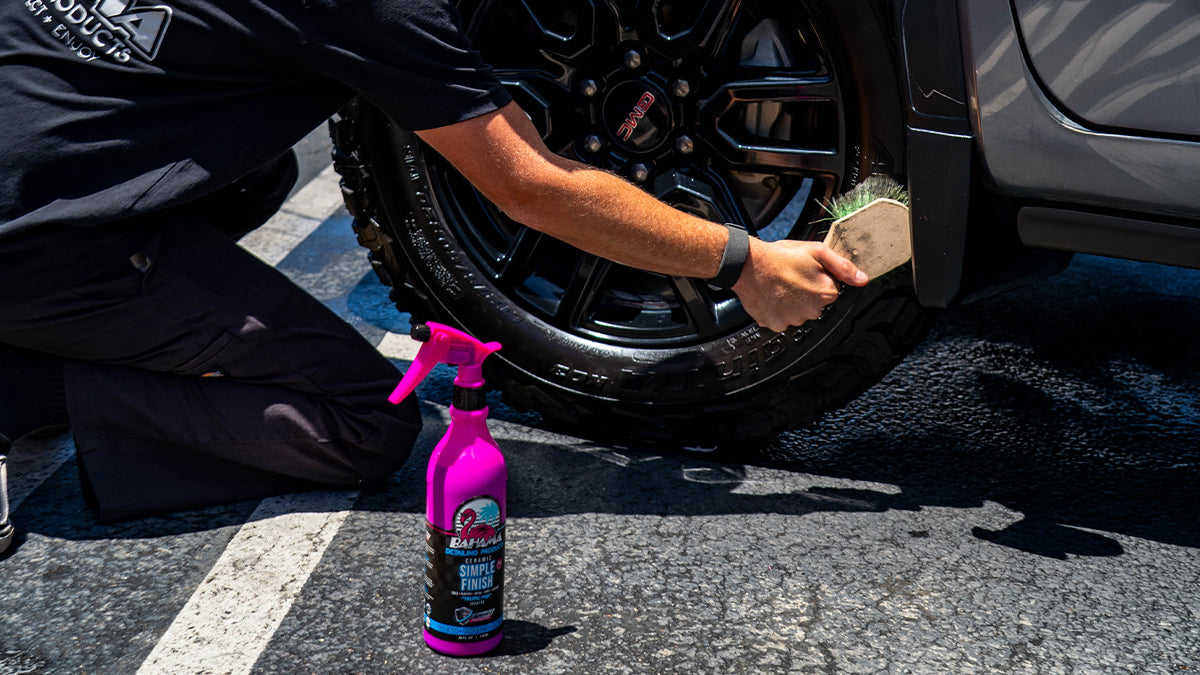
- Foam and scrub. Hit the tire with Ceramic Mega Foaming Soap and scrub the sidewall with a stiff tire brush. Keep going until the foam comes off white instead of brown.
- Do the wheel while you are there. Use a soft wheel brush on the face and barrel so you are not dragging brake dust back onto a clean tire.
- Rinse well. Leftover soap film is another layer between the dressing and the rubber.
- Dry it. Water on the sidewall dilutes the dressing and keeps it from bonding evenly.
If your tires have years of old silicone dressing caked on, plan on two rounds of scrubbing the first time. After that, maintenance washes go quickly. Off-road tires get extra grime in the lugs, and our off-road tire care guide covers that in detail.
The Routine: Wash, Dry, Restore, Protect, Finish
Tires are one part of a full detail, so here is the whole routine in order. Every bottle has a towel built for it.
- Wash. Foam the whole vehicle with Ceramic Mega Foaming Soap through a foam cannon or a bucket. It is pH-neutral, lifts road film and brake dust, and leaves a beading ceramic layer with SunShield UV behind. Scrub the tires and wheels with brushes, then rinse.
- Dry. Pull the big panels dry with a Big Bird and use a Lil' Bird for mirrors, jambs and the wheels. Blot rather than drag. Water spots are made in the drying, not in the wash.
- Restore. Spray Ceramic Simple Finish onto a Finish Line towel and wipe it across the sidewall, then the wheel. One light, even coat. Buff gloss rim faces with the plush side so they stay crisp. Do the plastic trim with the same towel and bottle.
- Protect. On paint, glass and chrome, use Ceramic Final Touch Detail Spray. Spray, wipe it smooth into an even layer, and let it dry 5 minutes.
- Finish. Buff the Final Touch off with a dry Victory Lap. Keep the vehicle dry for about 24 hours so it cures.
Keep the Finish Line towel on wheel and tire duty only. A towel that has been through brake dust and tire dressing has no business on your paint or your dash.

Wheels, tires and trim. Dual-sided: a short nap to lift grime and a plush side to wipe it clean, so your finishing towels never do the dirty work.
Application Mistakes That Shorten Dressing Life
Using too much
More product does not mean more protection. A heavy coat stays wet, grabs dust and slings. Wipe on a thin coat and work it into the rubber. If the tire looks dripping wet, you used too much.
Spraying straight at the tire
Overspray lands on the brake rotor, the paint and the driveway. Spray onto the towel instead, then wipe it on. You control exactly where it goes.
Skipping the wipe-down
Run the clean side of the towel over the sidewall once more after the coat goes on. That evens out any heavy spots and is the best insurance against sling.
Driving off in the rain
Give the dressing time to set before the tires meet standing water. Dress the tires early in the detail, before you move on to paint, and they will be ready by the time you are done.
How Often Should You Reapply Tire Dressing?
Reapply when the tires tell you to, not on a calendar. Watch for two signs: water stops beading on the sidewall, and the black starts to soften toward gray.
Sun, heat, mileage and how often you wash all change the timing. A garaged weekend car holds its dressing much longer than a truck parked outside in the desert. Since Simple Finish builds with every application, each coat goes on easier and holds better than the one before.
The easiest habit: give the tires a quick wipe with Simple Finish every time you wash. It takes a couple of minutes per side and keeps the rubber protected all the time, not just after a big detail.
Frequently Asked Questions
Why do my tires turn brown after I dress them?
Brown is old, degraded rubber and blooming compounds on the surface. Scrub the sidewall with soap and a stiff brush until the foam runs white, dry it, then dress. Dressing over the brown film will not hold.
How do I stop tire dressing from slinging onto my paint?
Use a thin coat, apply it with a towel instead of spraying the tire directly, and wipe off any excess. Simple Finish goes on dry to the touch, so there is no wet film to fling.
Can I use the same product on my tires and wheels?
Yes. Ceramic Simple Finish is made for the tire and rim together. On gloss rims, give the face a quick buff afterward with the plush side of a Finish Line towel.
Does tire dressing protect against UV?
Many do not. Simple Finish carries SunShield UV, so it protects the rubber from the sun as well as restoring its color. That is what slows fading and cracking on the sidewall.
Can I put tire dressing on my plastic trim too?
With Simple Finish, yes. The same bottle restores faded plastic, trim, rubber and wheels. Our guide to restoring faded plastic walks through it.
The Bottom Line
Tire dressing fails when it goes on a dirty tire, sits on top as an oily film and does nothing about the sun. Clean the rubber properly, use a thin bonding coat with UV protection, and keep a dedicated towel for the job. Wash. Restore. Protect. The Full System Set puts all four bottles in your garage, and the Premium Towel Set gives each one its own towel: one towel per job, zero cross-contamination.

Wash, interior, restore and protect: all four Bahama ceramic bottles in one set. A pro ceramic coating is $1k+. This system only takes a couple hours.

Drying, interior, wheels and trim, and buffing the Final Touch coating, each with its own towel. No wheel grime on the dash, no drying towel soaking up your coating.