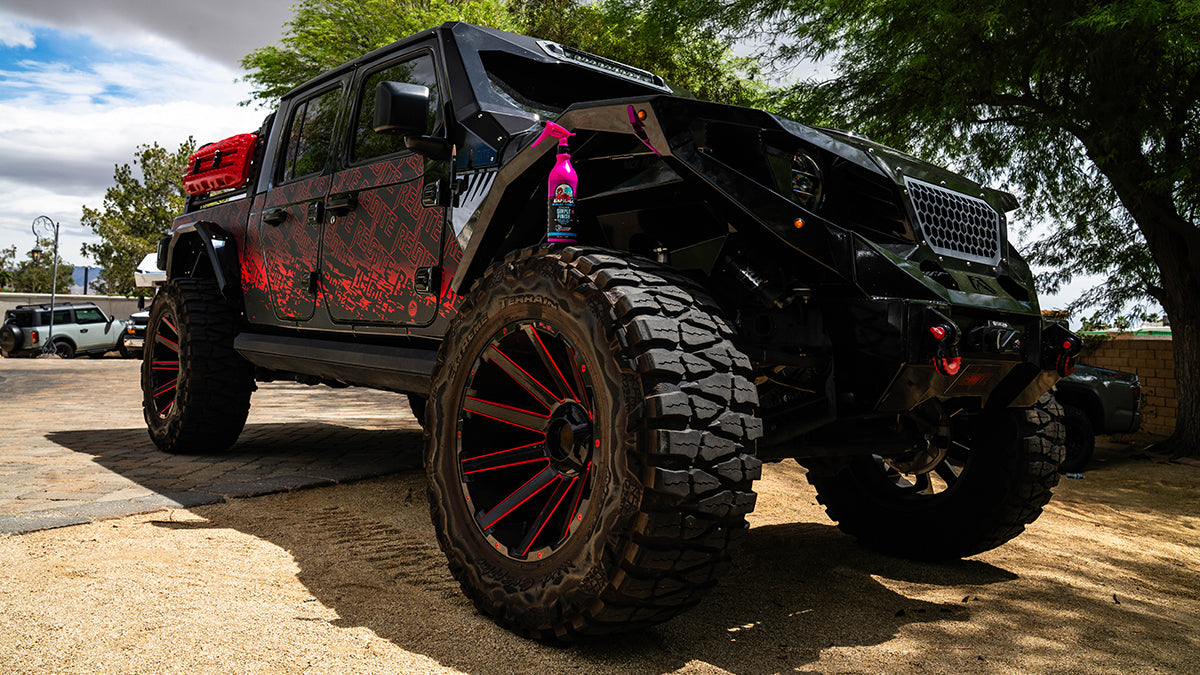
The wheels and undercarriage of an off-road truck take the worst of every trail run. Mud packs into the wheel wells, rocks lodge in the suspension, and grime coats the frame, skid plates and brakes.
Clean off-road truck wheels and the undercarriage the same day you get home, before the mud dries hard. Rinse from the bottom up, foam, brush, rinse again, then dry and protect the tires, wheels and trim. Here is the full process.
Why Clean the Undercarriage After Every Trail Run?
It is tempting to wash the paint and leave the underside for later. Don't.
- Mud holds moisture. Packed mud keeps water against the frame, brackets and fasteners long after the trail has dried.
- Debris hides damage. You can't spot a torn boot, a bent tie rod end or a leaking shock under a layer of clay.
- Packed wheels vibrate. Mud caked inside a wheel throws off balance and causes a shake at highway speed.
- Grit wears parts. Sand and fine grit in the suspension and brakes act like sandpaper on every moving part.
Salt is the same story. If you run winter roads or beach trails, wash the underside even more often.
What You Need
- A pressure washer with a wide fan tip, or a hose with a strong nozzle. An undercarriage wand that rolls under the truck helps a lot.
- Ceramic Mega Foaming Soap and a foam cannon or a Grit Guard Bucket.
- A soft wheel brush, a long wheel well brush and a stiff tire brush.
- A Big Bird for the body and a dedicated Finish Line towel for the wheels and tires.
- Ceramic Simple Finish for the tires, wheels, plastic and trim.
- Gloves, eye protection and a creeper or a mat if you are going under.
How to Clean Off-Road Truck Wheels and Undercarriage, Step by Step
1. Let It Cool, Then Knock Off the Big Stuff
Hot brakes and hot exhaust don't mix with cold water. Give the truck time to cool. Then pull out rocks and sticks from the wheels, tread and suspension by hand, and scrape heavy clay out of the wheel wells.
2. Rinse the Underside First, Bottom Up
Start with the frame rails, axles, skid plates and wheel wells. Rinse from the front back so the mud flows out the rear. Keep the jet off wiring connectors, breather tubes, seals and bearings. Use the wide fan and let volume do the work instead of point-blank pressure.
3. Foam and Brush the Wheels and Wells
Foam the wheels, tires and wheel wells with Mega Foaming Soap and let it dwell so it can lift the mud and road film. Work the barrel and spokes with the soft wheel brush, the tire with the stiff brush, and the wells with the long brush. Rinse brushes often.
4. Wash the Body Last
Now the dirty work is done, wash the body top down with foam and a mitt from the Grit Guard Bucket. Washing the paint last means mud from the underside doesn't splash onto clean panels. Our guide on washing off-road trucks and 4x4s covers the body in more detail.
5. Final Rinse and Inspect
Rinse everything again, underside last. With the mud gone, take a slow look at boots, bushings, brake lines, skid plates and the tire sidewalls for cuts or bulges.

Thick cannon foam that lifts road film, mud and bug guts, then leaves a beading ceramic layer behind. pH-neutral, so it is safe on any coating.
Dry, Restore and Protect: The Finishing Steps
Clean is half the job. The rest is drying and protecting so the next trail run washes off easier. Follow the Bahama order: Wash, Dry, Restore, Protect, Finish.
- Dry. Blot the body with the Big Bird, and use a Lil' Bird for mirrors, glass and door jambs. Water spots are made in the drying, not in the wash. Dry the wheels with the Finish Line towel, not the Birds, so brake dust never reaches your paint towels.
- Restore. Spray Simple Finish on the tire and rim together and wipe with Finish Line. It also handles plastic fender flares, black trim, rubber, bed liner and plastic splash shields. Faded surfaces come back with SunShield UV, and there is no sling down the side of the truck. Gloss rims get a quick buff after.
- Protect. Spray Ceramic Final Touch on the paint, glass and any chrome, including chrome wheels, which should never get Simple Finish. Wipe it smooth and let it dry 5 minutes.
- Finish. Buff with a dry Victory Lap, then keep the truck dry for about 24 hours so it cures.
Every bottle has a towel built for it, and on an off-road truck that matters. A towel that has been through brake dust and tire dressing has no business on your paint or your dash. One towel per job. Zero cross-contamination.

Faded plastic, trim, rubber and tires back to like-new, then protected. Just as good on matte, satin, PPF and vinyl wrap.

Wheels, tires and trim. Dual-sided: a short nap to lift grime and a plush side to wipe it clean, so your finishing towels never do the dirty work.
Make the Next Cleanup Easier
- Protect before the trail. A fresh Simple Finish layer on tires, wheels and trim, and Final Touch on the paint, give mud less to hold onto. Graphene + SiO₂ = hydrophobics, so water and muck have less to grip.
- Rinse at the trailhead if there is a wash bay. Mud that never dries is easy mud.
- Build layers. The chemistry builds with every application, so a truck on a regular routine gets easier to clean over time.
- Keep the kit together. A dedicated bucket and brushes for wheels means you never grab a dirty brush for the paint.
For the rubber side of things, see off-road truck tire care. For the whole truck, start with how to detail an off-road truck.
The Bottom Line
Rinse the underside first, foam and brush the wheels, wash the body last, then dry and protect with the right towel at every step. Do it the day you get home and the truck stays trail-ready. The Full System Set covers the wash, the interior, the restore and the protect for $135: one chemistry in four deliveries.
Frequently Asked Questions
Is it safe to pressure wash a truck's undercarriage?
Yes, with care. Use a wide fan tip, keep moving, and avoid aiming directly at wiring connectors, seals, bearings and breather tubes.
How often should I clean the undercarriage of an off-road truck?
After every muddy or sandy trail run, and regularly if you drive on salted roads or the beach. Fresh mud comes off far easier than dried mud.
What is the best way to get dried mud out of wheels?
Soak it first. Rinse, foam with a pH-neutral soap, let it dwell, then brush. Repeat until it softens instead of blasting at it.
Can I use the same towel on my wheels and my paint?
No. Keep a dedicated Finish Line towel for wheels and tires. Brake dust and grit picked up on wheels will scratch paint.

Wash, interior, restore and protect: all four Bahama ceramic bottles in one set. A pro ceramic coating is $1k+. This system only takes a couple hours.

Drying, interior, wheels and trim, and buffing the Final Touch coating, each with its own towel. No wheel grime on the dash, no drying towel soaking up your coating.